BPC-157
Body Protection Compound-157
A large rodent literature on tendon, ligament, muscle and gut healing, mostly from a small number of research groups in Croatia.
Almost all published work is animal-model. Human data is thin, read the limitations.
General profile
- Class
- Healing and tissue
- Evidence
- Mixed or moderate evidence
- Studied dose range
- 250–500 mcg (rodent-scaled literature)
- Frequency in protocols
- 1–2× daily in study protocols
- Route
- Subcutaneous
- Half life
- ~4 hours
- Reconstitution
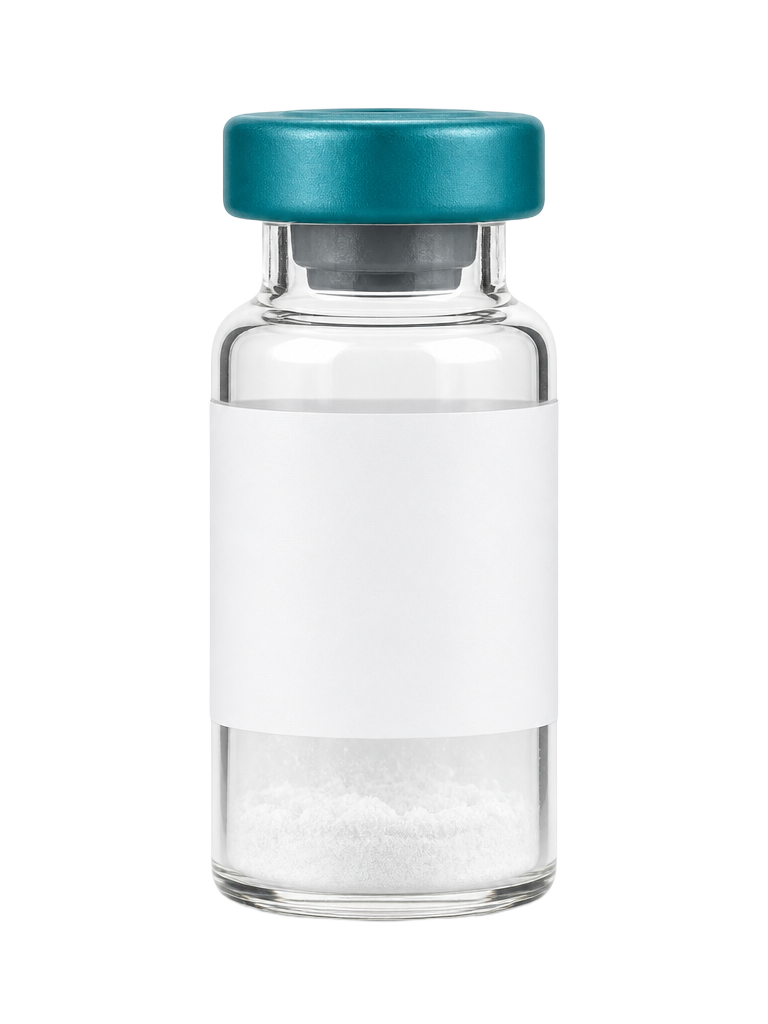
- 2 mL bacteriostatic water per 5 mg vial
- Storage
- Refrigerated once reconstituted, ~30 days
Timing and cycling in the literature
Usually dosed in the morning window
Daily, often split morning and evening in study protocols
Short plasma half-life of roughly 4 hours, so protocols split the daily amount rather than front-loading it. Timing relative to food is not a factor.
Reported cycle: 4 weeks on, 2 weeks off
Injury repair protocols in the animal literature run in short bursts tied to a healing window, not indefinitely. Four to six weeks covers most soft tissue timelines.
Watch for: Injection site irritation, and any new lump, mole change or unexplained pain. Angiogenesis is the whole mechanism, which is exactly why anyone with a cancer history should not be running it.
What it conflicts with
Three separate questions, kept separate. A hard stop means the mechanisms must not run together at all and timing does not fix it. A syringe rule means the same day is fine but one barrel is not. Redundancy is not dangerous, it is paying twice to hit one target.
- Hard stopBody level hard stop
BPC-157 + The window right after cardiac surgery
Not alongside an active cardiac recovery regimen
Bleeding risk and the cardiac drug regimen come first. Pro-angiogenic and vasodilatory compounds can clash with that care. Physician territory, not a timing problem.
- Hard stopBody level hard stop
BPC-157 + Active cancer, pregnancy or heavy immunosuppression
Absolute stop with an active cancer history
Angiogenesis is the whole mechanism people are chasing here, and it acts everywhere in the body, not only in the tendon you care about. Active cancer, pregnancy, major cardiac care and heavy immunosuppression override every stack preference.
- Hard stopTiming
BPC-157 + Wolverine (BPC-157 + TB-500)
Duplicate ingredient
The Wolverine blend already contains BPC-157. Adding it separately double doses one half of the blend while leaving the other half unchanged.
- Separate syringesSame day fine, same syringe not
BPC-157 + Melanotan II
Keep Melanotan II alone in the barrel
Melanotan II stays on its own even on a shared protocol day, and it reliably causes nausea, flushing and blood pressure changes in the first hours. If you introduce it next to anything else you cannot attribute a reaction.
- Separate syringesSame day fine, same syringe not
BPC-157 + TB-500
Valid protocol pair, separate syringes by default
Complementary jobs, local repair signalling versus cell motility and systemic repair logistics. Co-draw stability data is thin, so the default is two syringes on the same day.
- Separate syringesSame day fine, same syringe not
BPC-157 + Tesamorelin + Ipamorelin
That GH pair can share a barrel, BPC-157 stays out
Tesamorelin and ipamorelin sit in the same GH class and are co-drawn in practice. Adding a healing peptide to that barrel is a cross-family mix with no stability file.
- Pick oneRedundant, pick one
BPC-157 + Wolverine (BPC-157 + TB-500)
Same target hit twice
Wolverine already contains BPC-157.
- Pick oneTiming
BPC-157 + TB-500
Commonly paired in the literature
These two are studied together in repair models with no reported interaction. Still give them separate injection sites so any local reaction is traceable to one compound.
Most syringe compatibility claims here are practice and expert consensus, not peer reviewed mixing studies. A clear liquid after mixing does not prove the compounds are still active, and cloudiness, particles or gelling means discard. Active cancer, pregnancy, major cardiac care and heavy immunosuppression override every stack preference on this page.
See how BPC-157 fits your week
The injection scheduler spaces doses using the clinical timing data, flags the pairs above before you draw them, and tells you why.
Model this in the injection schedulerThe studies
Human trials: No completed, published human efficacy trial. Nothing is approved for human use anywhere.
Open questions: Dose translation from rodents is guesswork, and long-term angiogenic signalling has never been studied in people.
Published papers
Indexed from Europe PMC and refreshed weekly. Each link opens the paper itself.
- Effects of Supplementation in Masters Athletes and Older Adults: A Narrative Review
Curr Sports Med Rep · 2026 · Review. Nguyen C, Allen MR, Hornburg K, Fredericson M.
- Rapid and harmonized analytical workflow for the determination of peptidic and non-peptidic doping agents in dried and liquid blood matrices
Analyst · 2026. Mazzarino M, Colpaert T, Deventer K, Van Eenoo P.
- Therapeutic peptides and proteins: Status and developments in drug delivery
J Control Release · 2026 · Review. Hornsby BD, Lee CH, Steele CA, Tuekpe JKK, Lim CS.
- Unilateral Adrenalectomy, and the Stable Pentadecapeptide BPC 157 as Therapy in Rats-A Cytoprotection Approach
Pharmaceuticals (Basel) · 2026. Smoday IM, Vukovic V, Oroz K, Vranes H, Kalogjera L, Gamulin O, Vlainic J, Milavic M, Sikiric S, Nikolac Gabaj N, Marijancevic D, Koprivanac A, Tomic L, Strbe S, Barisic I, Beketic Oreskovic L, Kordic M, Tvrdeic A, Seiwerth S, Sikiric P, Boban Blagaic A, Skrtic A.
- BPC-157 and Its Novel Hybrid Analogs as Inhibitors of Acetylcholinesterase
Int J Mol Sci · 2026. Jelińska J, Józwiak M, Szeleszczuk Ł, Sikora K, Kamysz W, Kleczkowska P, Gackowski M, Grodner B.
- Current State of Orthobiologics in Treatment of Knee Osteoarthritis-Future Directions
Int J Mol Sci · 2026 · Review. Lee W, Ruan QZ, Hasoon JJ, Kulich RJ, Deer TR, Sayed D, Liongson FAZ, Hatfield E, Guirguis M, Kaye AD, McCormick ZL, Yong RJ, Robinson CL.
- Protective effects of BPC 157 in rats with experimentally induced lower extremity ischemia-reperfusion injury
Sci Rep · 2026. Yıldırım AK, Demirtaş H, Özer A, Arslan M.
- BPC-157 as an Investigational Peptide Therapeutic: Biopharmaceutical Challenges, Formulation Strategies, and Translational Development Barriers
Pharmaceutics · 2026 · Review. Mateescu DM, Gavrilescu DM, Constantinescu FE, Oancea C, Ilie AC, Folescu R, Popa MD, Iurciuc S, Muresan CO, Enache A.
- Injectable Peptides in Sports Medicine: A Structured Narrative Review of Evidence, Safety, and Antidoping Implications
JBJS Rev · 2026 · Review. Villegas Meza AD, Nocek M, Mitchell BC, Lizarraga M, DeFoor MT, Ruzbarsky JJ, Huard J, Philippon MJ.
- Endothelium-Dependent Nitric Oxide-Mediated Vasorelaxant Effects of BPC 157 in Human Internal Mammary Artery
J Clin Med · 2026. Yildirim AK, Dastan AO, Demeli Ertus M, Ensarioglu M, Karabacak K, Pehlivanoglu B.
Search the full literature
- PubMed: all indexed papers
Every indexed paper, newest first. Filter to Clinical Trial or Review in the sidebar.
- PubMed: human clinical trials only
The honest test of an evidence claim. An empty result is itself an answer.
- ClinicalTrials.gov registrations
Registered, ongoing and completed trials, including ones that never published.
- Europe PMC full text
Often surfaces open-access full text that PubMed only abstracts.